Fusce varius, dolor tempor interdum tristiquei bibendum service life.
We provide high quality custom camelid single-domain antibodies (sdAbs, aka VHHs, nanobodies). Benefit from > 25 years know-how in nanobody discovery & applying them in diverse biological and clinical backgrounds. We also offer in-house developed nanobodies.
These problems are not encountered with Nanobodies.
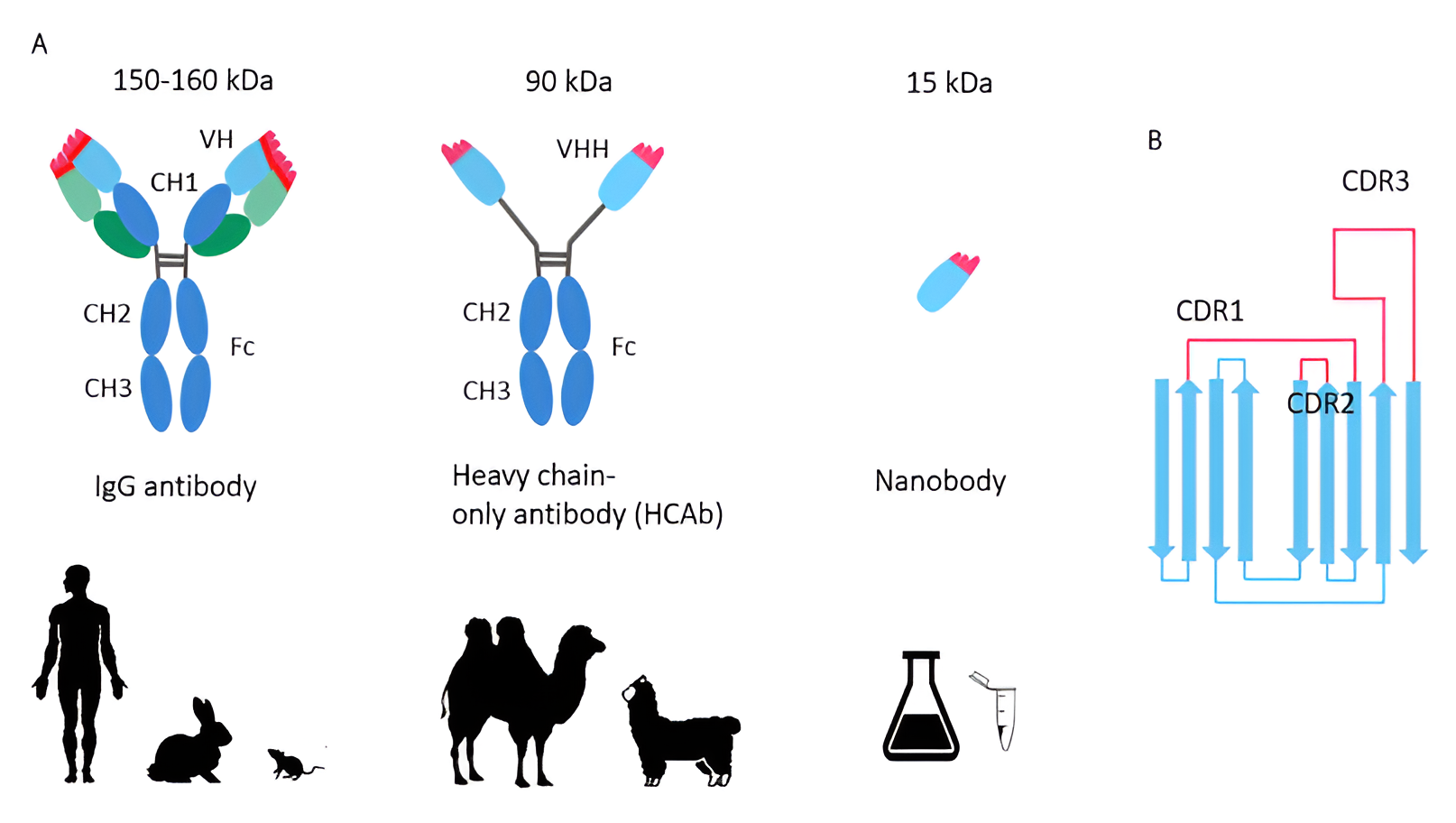
Heavy chain only antibodies (HcAbs) from camelids were discovered in Brussels, Belgium (figure below). The antigen-binding fragment of such a HcAb is called a nanobody, VHH, or single domain antibody. Belgium is a hub for nanobody research in academia and private enterprises alike.
Conventional antibodies, heavy chain-only antibodies (HCAbs) and nanobodies (Nbs) (A) HCAb (middle) consists of 2 heavy chains only. Its antigen binding part is a VHH and a single amino acid chain of ~120 aa (15 kDa). (B) CDR (complementarity determining regions, red) and FR (framework regions, blue) of a nanobody. The CDRs are important for antigen binding and are usually longer than their IgG counterparts, allowing nanobodies to access difficult to reach epitopes, such as enzyme catalytic sites.
Include this technology into your next grant application or better even, contact us today. We guide you through the process, keep you up to date and help you further once you obtain your VHHs of interest. Our academic branch researchers have more than two decades of experience in applying them in research.
Whether you are working in fundamental or applied (bio)medicine, animal or plant sciences, pharmacology, virology, microbiology, (super-resolution) microscopy, vaccines, fisheries, VHHs offer many opportunities to uncover biological/clinical information that cannot be achieved by using either conventional genetic approaches or conventional antibodies. The reason is that proteins are essential building blocks in every living organism and contribute to health and disease in the most fundamental manner.
Genetic approaches invariably result in eradication of all functions of the protein of interest as well as obliteration of its entire interaction network. Proteins have many associates, building an interaction network that supports many cellular functions. Implementing VHHs/Nanobodies in your research adds a new level to your project and enables you to ask new questions that you were not able to answer before and address them experimentally.
Key examples where VHHs typically outperform IgGs
- 10x smaller than IgGs.
- Long CDRs for blocking enzymes or perturbing protein-protein interactions in vitro and in vivo.
- Great tool for proteomics.
- Inhibitors against structural proteins mostly unavailable – nanobodies fill this gap.
- Subtle blocking of protein functions rather than blasting the POI to smithereens with RNAi.
- Understand the biology of your protein target in greater detail.
- Nanobodies are stable in the cytoplasm of cells (reducing environment).
- Nanobody cDNA always available, by default.
- Circumvent GFP-fusion protein overexpression and unbalancing protein homeostasis.
- Target the endogenous protein when used as intrabody.
- High affinity binders (nanomolar to picomolar).
- Imaging your target remains possible (not with RNAi).
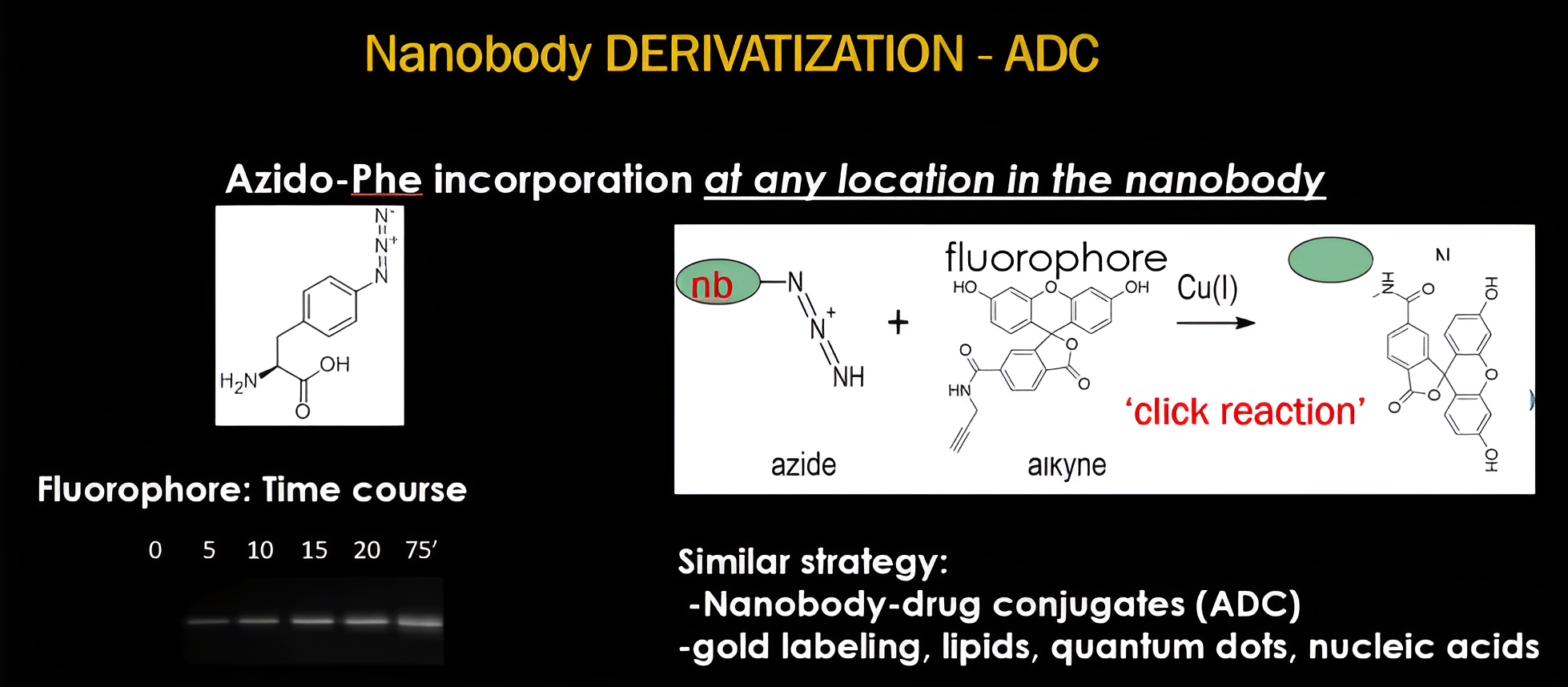
- Insert unnatural amino acids in their primary structure, site specifically.
- Site specific coupling of fluorophores, minimal linkage error for super res microscopy.
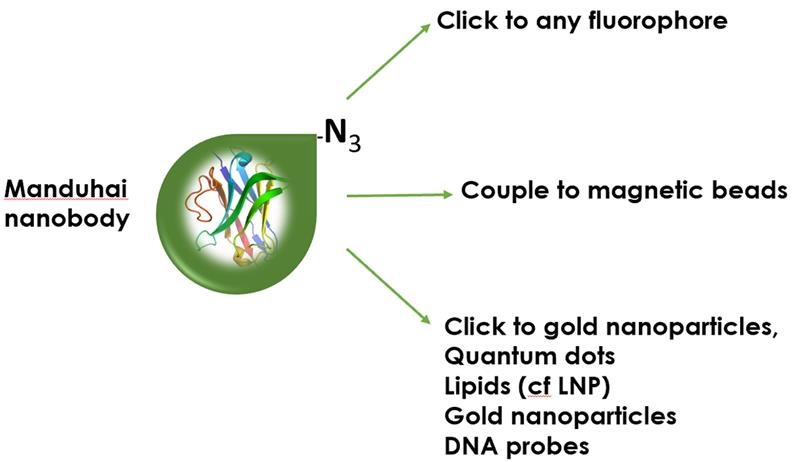
- Click nbs covalently to fluorophores, magnetic beads, gold nanoparticles, biologicals, drugs.
- Nanobodies are conducive to protein crystallization.
- Identify important epitopes in the protein of interest.
- Drug ‘undruggable’ proteins.